
Safeguarding Procedure
Purpose and Scope
iungo Solutions Limited (“iungo”) is a new generation of Digital & Green Skills training provider developing and delivering employer-led immersive and experiential learning programmes for priority growth sectors.
The purpose of this Procedure is to provide an overview of the way in which iungo handles safeguarding concerns relating to participants who are children or adults at risk. This procedure is intended for use by iungo employees, contractors, and volunteers, collectively referred to as “representatives”, who interact with and/or have responsibility for participants.
This Procedure recognises and applies to all types of abuse including emotional, physical, sexual and neglect, and any concerns related to radicalisation.
Employees are obliged to report safeguarding concerns as soon as they become aware of them. If an employee feels unable to raise a non-statutory safeguarding concern through this Procedure, they can report the concern anonymously via the FOR-0018 Confidential Employee Reporting Form.
Effective Safeguarding Procedure
The main characteristics of an effective safeguarding structure are as follows:
- Employees who are trained to recognise safeguarding concerns
- Employees who are alert and responsive to report safeguarding concerns
- Clear expectations placed upon employees to report safeguarding concerns
- A clear and straightforward means of reporting safeguarding concerns
- Clear responsibilities for investigating safeguarding concerns
- A forum to discuss and take positive steps to improve safeguarding arrangements
- A formal recording system for safeguarding concerns, investigations and actions
Being Aware of Safeguarding Concerns
All employees must be vigilant to safeguarding issues at all times. Programme Tutors must review the Participants Database to ensure that you have taken account of any learning barriers, Additional Learning Needs (ALNs) or other concerns cited by participants in their onboarding.
Programme Tutors have a responsibility to ensure that any observations of potential ALN or need for enhanced support are logged in the Participants Database as they arise. These should be documented in the Learning Passport.
They should raise observations in the Daily Tutor Wash Through and their Daily Shift Handover Reports to identify where an individual may require additional support. This should be done so anonymously using the CRM ID.
Responding to Safeguarding Concerns Raised by a Participant
If a participant raises a potential safeguarding or wellbeing concern to you, you must:
- Be available to listen to the participant
- Ensure that you are in a suitable environment to have a potentially sensitive conversation
- Ask open ended questions if you are able to to ascertain key facts and details – do not ask leading questions
- Outline support options that are available to Participants
- Make the participant aware that you are required to report safeguarding concerns and that you cannot promise confidentiality
- Report the safeguarding concern as per Section 6.
It is not your role to investigate safeguarding concerns and you must not share any information with people except for the Designated Safeguarding Officer.
Escalating Safeguarding Concerns
Any employee who suspects a safeguarding or wellbeing concern should report it by email to the Designated Safeguarding Officer at safeguarding@iungo.solutions. This is a confidential reporting email.
The email should include as much information as possible, including as a minimum:
- The date and time
- The CRM ID of the participant you are concerned about
- Any other people involved and their roles (employee, participant, member of public, family etc.)
- The place where the incident occurred (if known)
- A summary of the concern and a detailed account, including a description of any injuries you have seen
Escalation Timescales
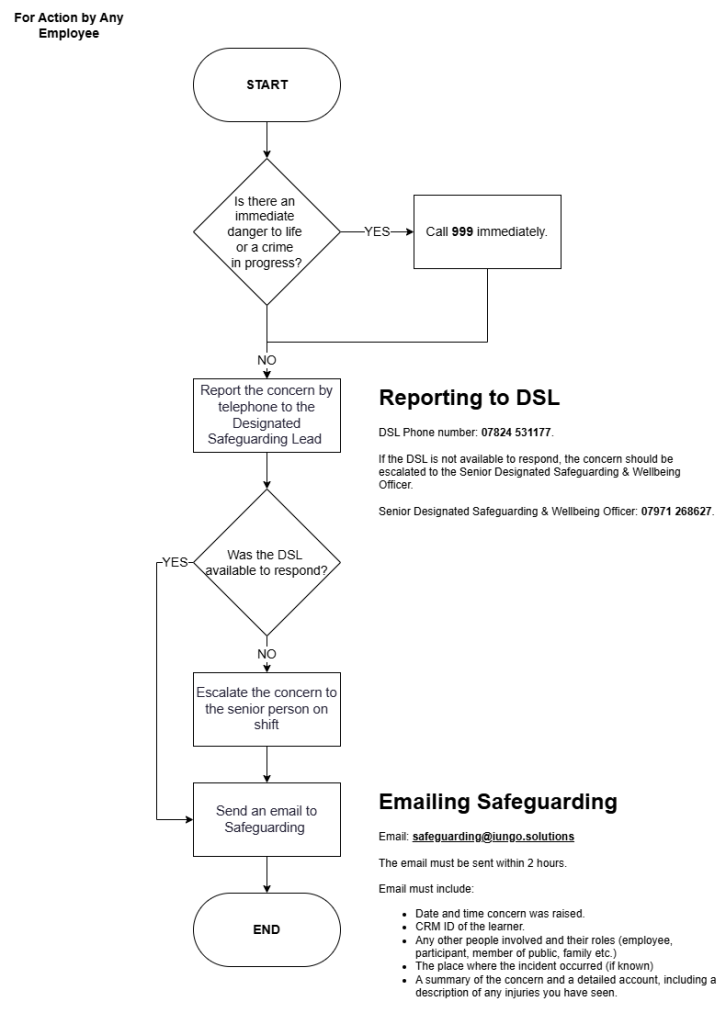
- Call 999 immediately (if there is a risk to life or a live crime in progress)
- Report the concern immediately by telephone to the Designated Safeguarding Lead (DSL) on 07824 531177*
- Send an email outline the safeguarding concern to safeguarding@iungo.solutions within 2 hours.
You should submit the email as soon as possible after you become aware of the safeguarding concern. If you suspect that the participant is in immediate danger, you must:
*If the DSL does not respond, call the Senior Designated Safeguarding & Wellbeing Officer on 07971 268627. In the unlikely event that neither responds, escalate to the Senior Person on Shift.
Refer to Appendix A for the Escalation Flowchart.
Investigation Safeguarding Concerns
The Designated Safeguarding Officer (DSO) is responsible for coordinating the investigation of all reported concerns to determine the appropriate pathway and support requirements. It is not the role of the reporting employee to investigate.
Initial Triage and Evidence Gathering
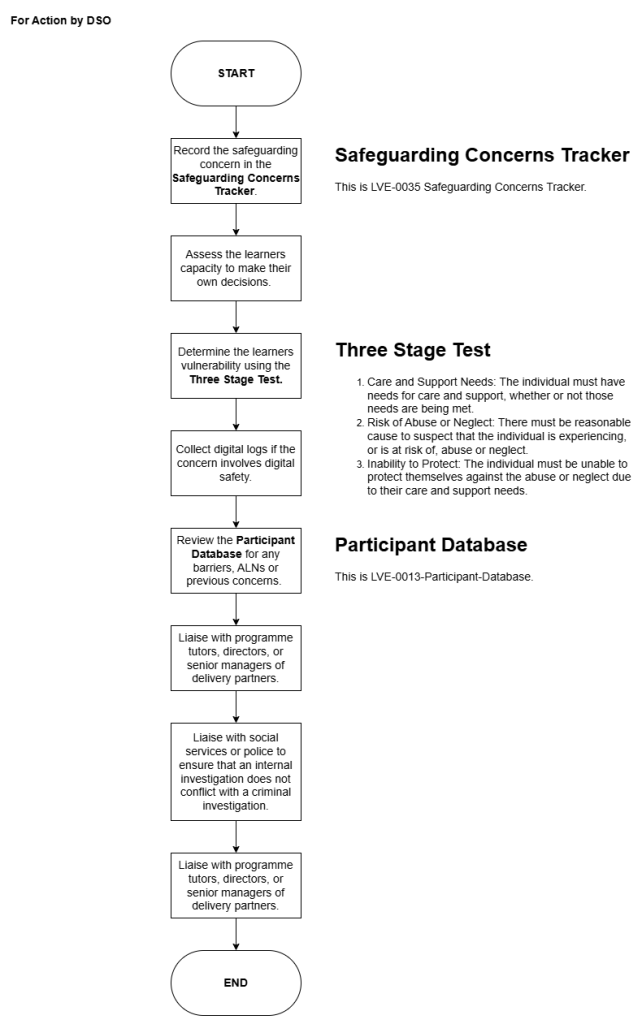
Upon receipt of a report via safeguarding@iungo.solutions, the DSO will:
- Record the Information: Immediately log the concern in the LVE-0035 Safeguarding Concerns Tracker.
- Assess Capacity: Determine if the individual has the mental capacity to make their own decisions regarding the disclosure.
- Determine Vulnerability: Apply the “Three-Stage Test” to decide if the individual meets the statutory definition of an Adult at Risk under the Care Act 2014 (England) or the Social Services and Well-being (Wales) Act 2014.
- Secure Digital Evidence: If the concern involves digital safety, the DSO will ensure screenshots or logs of online interactions are preserved before they can be deleted.
Conducting the Investigation
The DSO will use TEM-0086 Safeguarding Investigation Report Template to document the following:
- Fact-Finding: Reviewing the Participants Database for any pre-existing barriers, Additional Learning Needs (ALNs), or previous concerns.
- Consultation: Liaising with Programme Tutors, Directors, or senior managers of delivery partners to gather context while maintaining strict confidentiality.
- Liaison with Authorities: Consulting with Social Services or the Police to ensure an internal investigation does not compromise an official criminal investigation.
Outcome and Documentation
The investigation must conclude with a clear rationale for the chosen pathway:
- Statutory Referral: Made if the adult is at risk or if there is a legal requirement to report (e.g., Prevent Duty).
- Welfare Support: Initiated for non-statutory cases, focusing on internal adjustments and signposting to specialist agencies.
- Executive Reporting: The outcome and any “lessons learned” must be reported to the Executive to inform future policy and training.
Refer to Appendix B Investigation Flowchart.
Handling of Allegations of Abuse
The Designated Safeguarding Officers will record all the relevant information arising from the initial report and any subsequent enquiries and observations that inform their investigation.
This investigation will form the basis of any decision to refer to external agencies.If a referral is made, they will ask for consent from the young person/adult at risk if they are deemed competent to give it.
Agencies to whom a referral may be made include:
- The Local Authority as the lead organisation for safeguarding children and adults at risk
- The Police where a criminal offence is alleged or witnessed
Allegations of Abuse Against a iungo Representative
Where an allegation of abuse against a iungo Representative occurs, the procedure outlined in Section 7 will still apply. However, the Disciplinary and Grievance Procedure will also apply to the individual concerned.
Initially, the Designated Safeguarding Officer will inform the Group CEO of the allegation. Advice will be sought on whether to suspend the individual whilst an investigation is carried out. This decision should be made and actioned within the same day that the allegation of abuse is made.
If an employee leaves the business before the disciplinary process is completed, they will be informed of iungo’s duty to notify the Disclosure and Barring Service of the situation.
If the allegation is found to be without foundation, no disciplinary action will be taken. The employee will be informed of this in writing as per the requirements of the Disciplinary and Grievance Procedure. The person who alleged the abuse, will be informed of the outcome, and where necessary, restorative meetings will take place to repair any breakdown in professional relationships.
In all cases, the Designated Safeguarding Officer will lead a review of the investigation to ascertain whether lessons can be learned; this review will be reported to the Executive and will inform HR Screening, Safeguarding, and Learning & Development policies and procedures.
Reporting Safeguarding Concerns
If the DSO believes that the individual is in immediate danger they must follow the escalation procedure outlined in Section 6.1 in all cases.
Reporting Statutory Safeguarding for Children and Adults at Risk
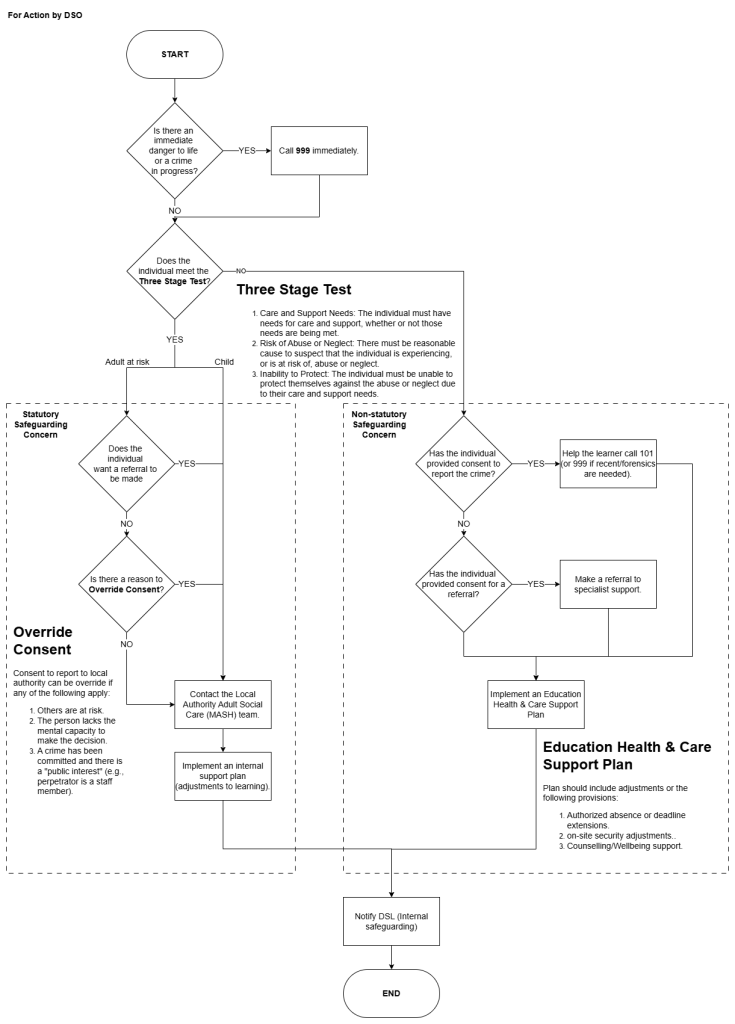
This pathway is reserved for individuals who meet the Three-Stage Test under English or Welsh law.
- Criteria: The individual is a child, or an adult at risk (has qualifying care and support needs), is experiencing or at risk of abuse/neglect, and is unable to protect themselves because of those needs.
- DSO Action: The DSO will record all relevant information and conduct an initial investigation to inform the referral.
- External Referral: A formal referral will be made to the Local Authority Social Services as the lead agency for safeguarding.
- Consent: Not required for children. Consent should be sought from adults, however, it may be overridden if others are at risk or if it is in the public interest.
- Police Involvement: The Police will be contacted immediately if a criminal offence is alleged, witnessed, or if there is an immediate danger to life.
Reporting Non-Statutory Safeguarding or Wellbeing Concerns
This pathway is utilized for learners who do not meet the legal definition of an Adult at Risk but require support following a serious incident, such as a victim of crime who has full mental capacity.
- Criteria: Any learner or representative experiencing harm, online harassment, or personal crisis where statutory criteria for “Adult at Risk” are not met.
- DSO Action: Focus shifts to an Education Health & Care Support Plan, which may include authorised absences, deadline extensions, or on-site security adjustments.
- External Referral: Referrals are primarily made to specialist support agencies (e.g., SARCs, Rape Crisis, or Mental Health charities) rather than Social Services.
- Consent: For non-vulnerable adults, informed consent is absolute . iungo will not report a crime to the police on behalf of a competent adult without their express permission, unless there is a direct threat to the lives of others.
- Internal Documentation: All actions and the rationale for not pursuing a statutory referral must be logged in the Safeguarding Concerns Tracker (LVE-0035).
Refer to Appendix C Reporting Flowchart.
Documenting Safeguarding Concerns
All safeguarding and wellbeing concerns are documented in the LVE-0035 Safeguarding Concerns Tracker. Any concerns raised will be investigated by the Designated Safeguarding Officer using the TEM-0086 Safeguarding Investigation Report Template and summarised in the Tracker.
The Tracker and associated Safeguarding Investigation Reports are held in an access controlled Drive to which only the Designated Safeguarding Officer has access. The Designated Safeguarding Officer can add permissions to specific documents where they need to share investigation reports with the Employee Experience Team as needed.
The Designated Safeguarding Officer is required to report the outcome of Safeguarding Investigations to the Executive so that lessons can be learned and actions can be taken to improve culture, policies and procedures.
Promoting Wellbeing and Safeguarding to Employees
New employees are required to undertake Safeguarding and Prevent training during their first week of employment, as mandated by PRO-0019 Internal Recruitment and Onboarding Procedure. The Quality and Compliance Manager is responsible for ensuring that all employees undertake refresher training in Safeguarding and Prevent on an annual basis. This is recorded in the LVE–0022 Tutor Compliance Tracker.
The Designated Safeguarding Officer will issue guidance to employees on how to recognise and respond to matters of wellbeing or safeguarding concern. General concerns and observations, not relating to a specific individual or incident, will be discussed in the weekly meetings so that Programme Tutors with responsibility for Participants are aware of new developments and techniques for promoting positive wellbeing and safeguarding.
Related Documents
| Document Reference | Document Title |
| POL-0012 | Safeguarding Policy |
| PRO-0019 | Internal Recruitment and Onboarding Procedure |
| LVE-0035 | Safeguarding Concerns Tracker |
| LVE-0022 | Tutor Compliance Tracker |
| TEM-0086 | Safeguarding Investigation Report Template |
| FOR-0018 | Confidential Employee Reporting Form |
Document Approval
| Authorising Name: | Jessica Leigh Jones MBE |
| Position: | Group CEO |
| Signature: |  |
| Document Version: | 1.2 |
| Date of Release: | 01/05/2024 |
| Date Updated: | 01/10/2025 |
| Date of Next Review: | 01/10/2026 |
| Document Classification: | Internal |
Appendix A: Escalation Flowchart
Appendix B: Investigation Flowchart
Appendix C: Reporting Flowchart